


Neurobiology Equipment
Understanding how the nervous system works often requires more than theory alone. In teaching labs, research training environments, and practical demonstrations, the right instruments help learners connect abstract concepts such as reflexes, sensory processing, bioelectric signals, and physiological adaptation with observable results. Neurobiology Equipment supports that transition from explanation to hands-on experience.
This category brings together tools used for demonstrating and exploring core topics in neurobiology, from reflex testing and electrophysiological recording to perception experiments and human physiology exercises. It is especially relevant for education-focused laboratories that need equipment suitable for guided experiments, repeated classroom use, and clear interpretation of biological responses.
Practical equipment for teaching neural and sensory function
Neurobiology teaching typically spans several related areas: nerve signaling, muscle response, reflex pathways, sensory perception, and the relationship between the brain and measurable body functions. Equipment in this category is therefore not limited to one single instrument type. Instead, it may include demonstration tools, recording accessories, and complete experiment sets designed to support structured learning.
For institutions building a broader life science lab environment, neurobiology often works alongside areas such as human physiology equipment and sensory or organism-based teaching resources. This makes the category useful not only for neuroscience-specific lessons, but also for interdisciplinary biology education.
Key application areas within neurobiology training
A major strength of this category is its relevance to experiments that students can directly observe and interpret. Reflex hammers, for example, support simple but effective demonstrations of neural pathways and motor response. A product such as the PHYWE KLA-110-525 Reflex Hammer is suitable for illustrating patellar and related reflex testing in a clear, low-complexity teaching setting.
Electrophysiological work adds another layer of depth. Accessories such as PHYWE 65981-01 ECG Electrodes and PHYWE 65981-02 EMG Electrodes help capture biological electrical activity for educational analysis. In classroom and lab contexts, these tools are useful for introducing signal acquisition concepts and showing how physiological events can be recorded, compared, and discussed.
Electrophysiology and measurable human responses
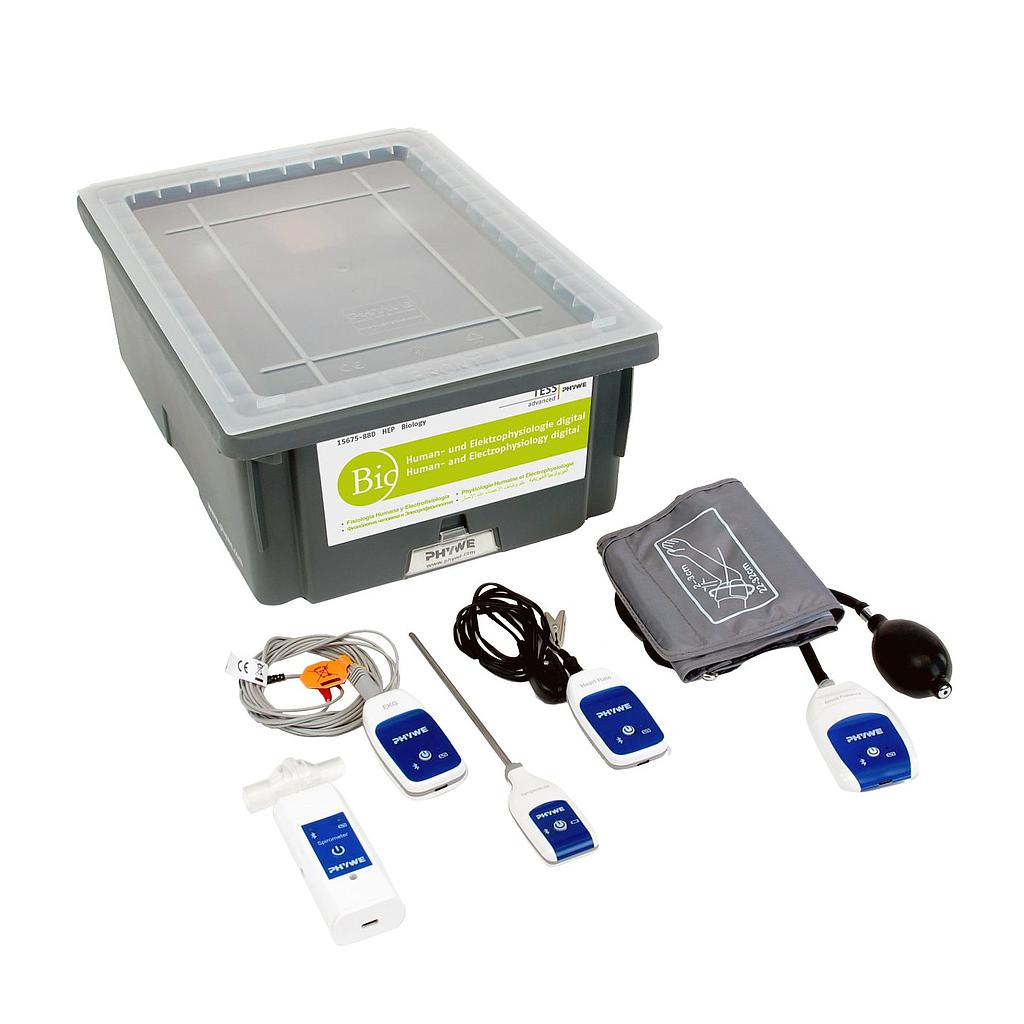
Many neurobiology lessons benefit from linking nervous system activity with measurable outputs from the body. The PHYWE 15675-88D Student Set Human And Electrophysiology Digital is a good example of how multiple physiological parameters can be explored in a coordinated way. It brings together experiments related to heart activity, blood circulation, skin temperature, pulse, blood pressure, and lung function using digital sensors for real-time measurement.
Although this kind of set extends into broader physiology, it remains highly relevant to neurobiology education because it helps learners understand bioelectrical measurement, physiological regulation, and the connection between signals and body function. In teaching environments that use tablets or smartphones for data logging, this type of setup also supports modern digital lab workflows and improves student interaction with experimental data.
Sensory perception and adaptation experiments
Neurobiology is not only about signals and reflexes; it also includes perception and how the brain adapts to altered sensory input. Devices such as the PHYWE DID-43000 Reversing Glasses and the PHYWE DID-43003 Set Prism Glasses In A Suitcase are well suited for demonstrating visual inversion, altered spatial perception, and habituation effects over time.
These experiments are valuable because they make sensory processing visible through student experience. Instead of discussing neural adaptation only in theory, instructors can use prism-based exercises to show how perception changes, how coordination is affected, and how the nervous system gradually compensates under unfamiliar visual conditions. This creates a strong bridge between behavioral observation and neuroscience concepts.
How to choose suitable neurobiology equipment
Selection depends first on the intended learning outcome. If the goal is introductory teaching, simple instruments for reflex and perception demonstrations may be enough. If the objective is more analytical, it makes sense to prioritize equipment that supports recording, comparison, and discussion of physiological signals, especially where students are expected to interpret measured results rather than only observe phenomena.
It is also useful to consider the learning format. For teacher-led demonstrations, durability and ease of setup are often the main priorities. For practical student work, features such as straightforward handling, reusable accessories, and compatibility with digital devices become more important. Institutions that already use products from PHYWE may also benefit from staying within a familiar ecosystem for consistency in training and lab operation.
Fit within a broader biology teaching environment
Neurobiology rarely stands alone in academic practice. It is often taught in parallel with topics such as cell structure, organism biology, and environmental response. Depending on the curriculum, schools and training centers may combine this category with resources for cell biology equipment when explaining membrane potentials and signaling fundamentals, or with zoology equipment for comparative biological study.
This broader context matters because neurobiology concepts become easier to teach when learners can connect neural function to anatomy, physiology, and organism behavior. A well-planned category page should therefore support both direct product selection and the wider educational workflow behind biology instruction.
What this category is designed to support
In practical terms, this category is suitable for schools, universities, training laboratories, and demonstration environments that need reliable tools for explaining neural response, physiological measurement, and perception. Some items serve as standalone teaching aids, while others function as part of a larger experimental setup involving sensors, electrodes, or digital data collection.
The value of neurobiology laboratory equipment lies in helping instructors turn complex concepts into repeatable demonstrations and meaningful student experiments. Whether the focus is reflex testing, electrophysiological recording, or altered visual perception, the category supports a more concrete and engaging approach to neuroscience-related education.
Conclusion
Choosing neurobiology equipment is ultimately about matching the device to the teaching objective, the learner level, and the practical format of the lab. Simple demonstration tools, recording accessories, and integrated experiment sets each play a different role, but together they help build a clearer understanding of how the nervous system and human responses can be observed in practice.
If you are comparing options for classroom experiments or training laboratories, this category provides a useful starting point for selecting equipment that supports both foundational demonstrations and more data-driven physiology work.
-
-
-
-
-
-
-
-
-
-
-
-
-
-
-
-
-
-
-
-
-
-
-
-