


Body thelmal Camera
Fast, non-contact temperature screening has become a practical requirement in hospitals, factories, offices, transport hubs, and public service environments. In these settings, a body thermal camera helps teams monitor skin temperature quickly while reducing direct contact and supporting smoother people flow at entry points.
Unlike general thermal inspection tools used for machinery or buildings, this category focuses on thermal imaging solutions intended for human temperature screening. The goal is not a clinical diagnosis, but efficient detection of elevated surface temperature so that staff can follow internal safety procedures or secondary checks when needed.
Where body thermal cameras are typically used
Body temperature screening cameras are commonly applied anywhere a large number of people must be checked without slowing down access control. Typical use cases include production plants, warehouses, schools, medical reception areas, office buildings, and visitor checkpoints.
Because they measure temperature without contact, these systems can help reduce bottlenecks compared with manual spot checks. For broader thermal inspection needs outside human screening, users may also compare solutions in the handheld thermal imaging camera range or explore fixed installations for continuous monitoring.
How this type of thermal imaging camera works
A body thermal camera detects infrared radiation emitted from the surface of the skin and converts it into a visible thermal image. The operator can then identify temperature patterns and check whether a person falls within a defined screening range or triggers a high-temperature warning workflow.
In practice, screening performance depends on more than the camera itself. Distance to target, ambient conditions, viewing angle, and the measurement area all influence the result. That is why buyers should evaluate not only image resolution, but also field of view, sensitivity, and the practical setup of the screening point.
What to consider when selecting a body temperature screening camera
The first consideration is the intended operating scenario. A compact camera may be suitable for controlled indoor checkpoints with moderate traffic, while larger or continuous-flow areas may require a different setup approach. Buyers should also confirm whether the system is designed specifically for body temperature screening rather than general industrial thermography.
It is also useful to review image resolution, temperature measurement range, display method, data storage options, and environmental protection. Features such as fixed focus, onboard display, and alarm support can simplify daily use, especially for routine access screening. If the application may evolve, related categories such as fixed thermal imaging camera systems can provide additional context for permanent installation projects.
Example product in this category
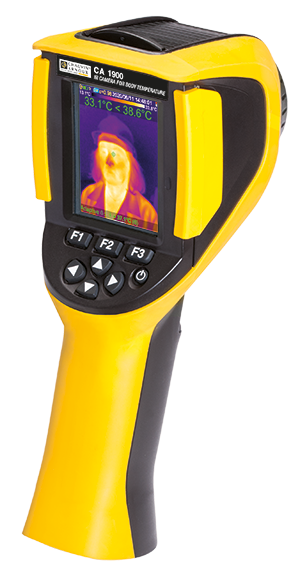
One representative model in this category is the Chauvin Arnoux C.A 1900, a thermal camera intended for measuring body temperature. Based on the provided product data, it uses a UFPA microbolometer detector, supports infrared and visible image display, and is designed for screening within a body temperature range of 30 to 45°C.
This model also illustrates several factors buyers often compare: thermal resolution, image presentation, portability, ruggedness, and operating conditions. Its configuration shows how body screening cameras can combine thermal measurement with practical field usability, which is important when equipment must be deployed at entrances, temporary checkpoints, or mobile screening stations.
Why brand and ecosystem matter
For B2B procurement, choosing a device is rarely only about one specification line. Availability, documentation, compatibility with site procedures, and confidence in the manufacturer all matter over the full lifecycle of the equipment. In this category, Chauvin Arnoux is a relevant brand for buyers looking for thermal measurement solutions with a recognized industrial instrumentation background.
It may also be helpful to consider the surrounding ecosystem, especially if the camera will be used as part of a broader thermal imaging workflow. In some projects, teams may later need lens and accessories for thermal cameras to adapt installation, transport, or day-to-day operation.
Operational considerations for reliable screening
Even a suitable camera should be paired with a clear operating process. A stable screening location, controlled ambient conditions, consistent measurement distance, and trained operators all contribute to more repeatable results. These points are especially important when screening is performed continuously over long periods.
It is equally important to communicate the role of the device correctly. A body thermal camera is generally used as a screening tool to flag potential elevated skin temperature, not as a standalone medical diagnosis device unless the manufacturer and the deployment context explicitly support that use. This distinction helps procurement teams align expectations, compliance procedures, and on-site workflows.
Choosing the right solution for your site
The right category choice depends on how and where screening will take place. A body thermal camera is usually the right fit when the main objective is checking people at entry points or controlled access areas with a dedicated temperature screening process.
If your application involves people screening rather than equipment inspection, this category provides a more focused starting point. Reviewing the deployment environment, throughput needs, and operating procedure will help narrow down the most suitable model and supporting accessories for reliable everyday use.
For organizations building a practical temperature screening setup, this category brings together solutions designed around speed, non-contact measurement, and operational convenience. A careful review of use case, screening conditions, and device features will lead to a more suitable selection and a smoother implementation in real-world B2B environments.
-
-
-
-
-
-
-
-
-
-
-
-
-
-
-
-
-
-
-
-
-
-
-
-