


Soil Moisture Meter
Reliable soil data makes a visible difference in irrigation control, crop health, greenhouse management, landscaping, and laboratory soil evaluation. When moisture is measured at the right time and in the right way, it becomes much easier to avoid overwatering, reduce plant stress, and support more consistent growing conditions. This is why a Soil Moisture Meter is widely used not only in agriculture, but also in horticulture, environmental monitoring, and research work.
On this category page, you can find instruments for quick spot checks in the field as well as more advanced sensors for longer-term measurement setups. The range includes handheld probes, portable digital meters, and sensor-based solutions designed for integration with data logging systems, helping users choose a method that fits their workflow rather than relying on guesswork.
Why soil moisture measurement matters
Soil water content directly affects root activity, nutrient uptake, and plant stability. If the soil remains too dry, plants may struggle to absorb nutrients efficiently and can enter water stress quickly. If it stays too wet, root-zone oxygen levels can drop and growing conditions may become unfavorable for healthy development.
Using a dedicated meter helps replace visual estimation with measurable moisture data. That is important for daily irrigation decisions, but also for comparing plots, checking substrate consistency, validating field conditions, or documenting results in professional cultivation and testing environments.
Common types of soil moisture instruments in this category
Not every application requires the same measurement method. Some users need a simple handheld unit for fast checks at multiple points, while others need a probe or sensor that can be connected to a monitoring system for repeated measurements over time.
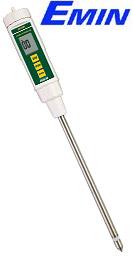
Handheld models such as the EXTECH MO750 Soil Moisture Meter, OMEGA HSM50, and PCE SMM 1 are suitable for direct on-site readings. These tools are practical when an operator wants to move across planting areas and check moisture conditions quickly. In contrast, Eijkelkamp HydraProbe models are better aligned with structured monitoring tasks where sensor communication, cable length, and logger compatibility matter.
For users who need a broader moisture measurement portfolio beyond soil alone, it can also be useful to review the moisture meter for agriculture range, where related applications may include crops, raw materials, and other agricultural media.
Examples of products and measurement approaches
Several instruments in this category illustrate how different measurement tasks lead to different product choices. The EXTECH MO750 and PCE SMM 1 are compact handheld meters with integrated contact-style measurement, making them practical for routine field use where portability and quick response are priorities. The OMEGA HSM50 follows a similar handheld approach for straightforward moisture checks.
The ATAGO PAL-Soil takes a different route by supporting gravimetric and volumetric soil moisture evaluation with a very small sample volume. This type of instrument is relevant when users need laboratory-style checking or a more controlled sample-based workflow rather than a simple probe insertion method.
At the sensor end of the range, Eijkelkamp HydraProbe SDI-12 Standard and Pro versions are intended for connected measurement environments. With multiple cable options such as 7.5 m, 15 m, and 30 m, these sensors are suited to installations where location, wiring distance, and data collection architecture are part of the selection process.
How to choose the right soil moisture meter
The first step is to define how the measurement will be used. For routine irrigation checks, a handheld unit with fast response and easy operation is usually the most practical choice. For repeated monitoring at fixed points, a sensor with communication capability may be more efficient, especially when readings need to be logged or integrated into a broader control system.
It is also worth considering the measurement principle, reading range, resolution, and operating conditions. Some instruments emphasize portability and simplicity, while others support more advanced workflows such as SDI-12 communication or sample-based testing. In outdoor work, power supply, probe construction, and cable length can influence long-term usability just as much as the meter's display or reading speed.
Brand preference may also play a role in standardization. Users who already work with OMEGA, ATAGO, EXTECH, PCE, Senseca, or Eijkelkamp equipment may prefer to stay within a familiar ecosystem for consistency in operation, maintenance, and support.
Applications across agriculture, landscaping, and research
In farming and greenhouse environments, soil moisture meters help operators fine-tune irrigation schedules and compare moisture conditions between beds, plots, or substrate zones. This supports more efficient water use and can improve consistency in crop management, especially where visual inspection alone is not reliable enough.
In landscaping and grounds maintenance, they are useful for checking root-zone conditions before watering trees, turf, or ornamental plants. In research, environmental monitoring, and soil laboratories, instruments may be selected for repeatability, formal testing workflows, or compatibility with specific evaluation methods.
Some projects also require related tools outside direct soil measurement. For broader field use cases, a multifunction moisture meter may be relevant when operators need flexibility across several materials instead of only soil.
Good measurement practice for more reliable results
Even a capable instrument performs best when the measurement method is consistent. Readings should be taken at comparable depths and similar locations if the goal is to track changes over time. It is also important to account for variations in soil texture, compaction, and local wetting patterns, because moisture can differ significantly across short distances.
For portable meters, keeping the probe clean and using stable contact conditions helps reduce inconsistent readings. For installed sensors, cable protection, power supply stability, and proper communication setup are all important. In any case, the most useful moisture data usually comes from repeated measurement routines rather than one-off checks.
Related instruments in the soil and moisture workflow
Soil moisture measurement is often only one part of a larger evaluation process. Depending on the application, users may also compare moisture with temperature, irrigation timing, substrate behavior, or soil water retention characteristics. For example, the Senseca ECO 122 Soil/Compost-Thermometer supports temperature checking in soil and compost processes, while the Eijkelkamp 08.27 Set for pF determination fits more specialized laboratory-oriented analysis.
This makes the category useful for both basic field inspection and more structured measurement workflows. Instead of treating every instrument as interchangeable, it is better to match the device to the measurement objective, the expected level of accuracy, and whether the task is mobile, fixed-point, or lab-based.
Conclusion
Choosing the right soil moisture meter starts with understanding how and where the readings will be used. A handheld meter may be the right fit for fast field decisions, while a connected sensor or sample-based device can be more appropriate for monitoring, comparison, or controlled evaluation.
This category brings together practical options from manufacturers such as EXTECH, ATAGO, OMEGA, PCE, Senseca, and Eijkelkamp, covering a range of workflows from simple spot measurement to more advanced sensor-based setups. If you are comparing instruments for irrigation management, cultivation, or technical soil assessment, focusing on application method first will lead to a more suitable selection.
-
-
-
-
-
-
-
-
-
-
-
-
-
-
-
-
-
-
-
-
-
-
-
-