


Moisture Meter for Agriculture
Accurate moisture control plays a major role in agricultural quality, storage stability, and trading decisions. Whether the task involves grain at harvest, coffee beans before processing, seeds for planting, or dried fruit for product consistency, selecting the right Moisture Meter for Agriculture helps teams make faster and more reliable decisions in the field, at receiving stations, and in quality control areas.
Within this category, the focus is on practical instruments designed for agricultural materials with different physical properties and measurement methods. Some models are optimized for cereals and oilseeds, while others are better suited to coffee, peppers, vegetable seeds, dried fruit, or broader food-related moisture checks.
Why moisture measurement matters in agriculture
Moisture content directly affects storage life, drying efficiency, transport condition, and final product quality. If agricultural materials are stored above a suitable moisture level, the risk of mold growth, spoilage, weight loss, and quality downgrade can increase quickly. On the other hand, overdrying may also reduce product value or processing yield.
For this reason, moisture meters are commonly used to support harvest timing, incoming goods inspection, drying control, and warehouse acceptance. In many operations, quick spot checks are just as important as laboratory verification, especially when procurement speed and batch consistency are critical.
Common measurement approaches for agricultural products
Different agricultural moisture meters use different principles depending on the sample type and required workflow. A large number of portable grain and seed instruments work by electrical resistance or electrical impedance, where changes in water content affect the electrical behavior of the sample. This approach is widely used for grains, beans, seeds, and similar commodities because it offers fast readings and practical portability.
Other devices in this category are designed for more specialized products. For example, refractometer-based moisture estimation is used in certain dried fruit applications, where the reading is derived from Brix-related measurement and displayed as approximate moisture content. In more controlled quality environments, users may also compare handheld checks with broader moisture testing workflows or complementary tools such as a multifunction moisture meter when multiple material types need to be managed.
Product groups covered in this category
This category includes portable and application-specific instruments for a wide range of agricultural materials. Grain-focused models are among the most common, supporting crops such as wheat, corn, rice, barley, soybeans, rapeseed, millet, sunflower seeds, coffee beans, and cocoa beans. A representative example is the PCE GMM 10 from PCE, which is designed for multiple cereal and seed types with automatic temperature compensation and a field-friendly sample workflow.
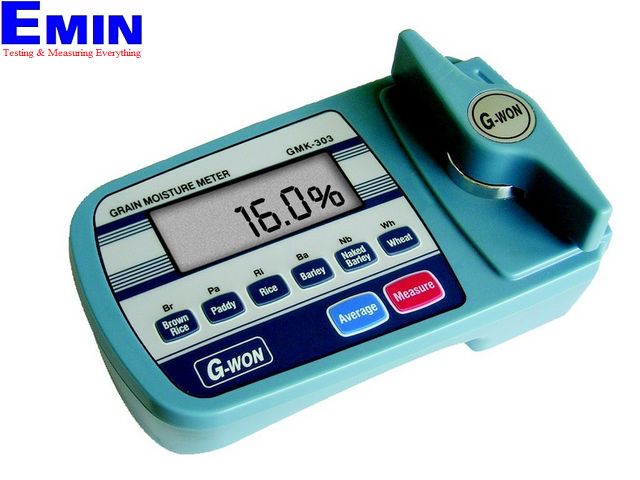
There are also specialized meters for coffee beans, vegetable seeds, and peppers. The G-won GMK-303C is intended for coffee bean measurement, while the G-won GMK-503S addresses vegetable seed applications across several crop types. For grain handling, models such as the Kett Fv211 and DRAMINSKI TGPRO TwistGrain Pro show the typical direction of this category: fast measurement, crop-specific calibration support, and practical operation for procurement or storage control.
Some instruments are built for niche product segments rather than bulk grain. ATAGO models such as PAL-Dried Fruit Moisture and PEN-Dried Fruit Moisture are relevant when approximate moisture evaluation is needed for dried fruits, while the PEN-Dates Moisture variant is tailored to dates. For broader food and agricultural material checks, the skSATO SK-960A type I can be useful where operators need a compact handheld tool for moisture screening across several product types.
How to choose the right agricultural moisture meter
The first point to check is the sample type. Grain, seeds, coffee beans, peppers, and dried fruits do not behave the same way during measurement, so crop-specific calibration or application-specific design is often more important than choosing a general-purpose device. If your operation handles several commodities, it is worth prioritizing a model that supports multiple preconfigured material selections.
The second point is the working environment. For field use, buyers often prefer handheld meters with battery operation, fast response time, and automatic temperature compensation. If measurements are performed repeatedly at a receiving point or in a controlled inspection area, a larger instrument with clearer sample handling and averaging functions may be more suitable.
It is also important to review the expected measuring range, resolution, and typical accuracy level for the relevant crop. In agricultural trading, a small difference in moisture reading can affect drying decisions, acceptance criteria, or pricing. When the workflow extends beyond crop moisture and includes root-zone checks, a separate soil moisture meter may be more appropriate than using a post-harvest material tester.
Examples of suitable instruments for different applications
For cereals and mixed grain handling, the PCE GMM 10 and G-won GMK-303F fit applications where operators need to switch between several agricultural materials. These types of instruments are commonly used for harvest intake, storage checks, and routine warehouse control because they combine portability with crop-oriented measurement settings.
For coffee operations, the G-won GMK-303C is more relevant because it is targeted specifically at coffee bean moisture. In seed-related workflows, the G-won GMK-503S addresses vegetable seed measurement, which can be especially useful when seed quality and storage condition must be checked before distribution or planting preparation.
When the product is dried fruit rather than grain, ATAGO offers a different measurement approach. The ATAGO PAL-Dried Fruit Moisture and ATAGO PEN-Dried Fruit Moisture models are examples of tools used for approximate water content assessment in dried fruit, while the ATAGO PEN-Dates Moisture is aimed at date products. For users looking for more brand-specific options in this segment, the ATAGO range is a natural reference point.
Typical use cases across the agricultural chain
Agricultural moisture meters are used at several stages of production and handling. Farmers and field teams use them to estimate harvest readiness and reduce post-harvest losses. Procurement teams use them to evaluate incoming lots quickly, especially where grain or seed quality must be checked before acceptance.
Drying and storage operations rely on moisture data to decide whether a batch needs further conditioning before warehousing. In processing plants, these instruments help verify raw material condition before cleaning, roasting, milling, packaging, or shipment. For hay-related materials or forage storage, a more specialized solution from the grass and straw moisture meters category may provide a better fit.
What to expect from a practical B2B selection
For B2B buyers, the best choice is usually the one that aligns with actual materials, operator skill level, and inspection frequency. Features such as automatic temperature compensation, clear LCD display, averaging function, battery operation, and crop-specific calibration support often matter more in daily use than broad but less relevant specifications.
This category is therefore best viewed as a selection of working tools for agricultural moisture control rather than a single universal device type. From compact handheld units for field checks to more specialized meters for coffee, dried fruit, seeds, or grain intake, the available options support a wide range of agricultural quality control tasks.
Final considerations
Choosing an agricultural moisture meter starts with understanding what you measure most often, where the measurement takes place, and how the result will be used. A grain-focused meter, a coffee bean device, a dried fruit refractometer, or a seed-specific instrument can each be the right answer when matched to the application correctly.
Explore this category to compare instruments by crop suitability, operating method, and workflow convenience. A well-matched moisture meter helps improve consistency, reduce storage risk, and support more confident decisions throughout the agricultural supply chain.
-
-
-
-
-
-
-
-
-
-
-
-
-
-
-
-
-
-
-
-
-
-
-
-