


Test weights M3
Reliable mass verification starts with choosing the right reference weights for the class of balance or scale in use. In routine industrial weighing, warehouse control, bench scales, and general checking tasks, Test weights M3 are commonly selected where practical verification is needed without moving into higher-precision laboratory classes.
This category focuses on OIML M3 test weights used to check, monitor, and support weighing equipment in day-to-day operation. The range includes multiple nominal values, shapes, and materials, making it easier to match a weight to the working capacity, handling conditions, and level of accuracy expected in the application.
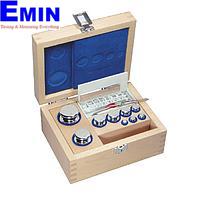
Where M3 test weights fit in practical weighing work
OIML M3 weights are generally used for routine checking and less demanding calibration or verification tasks, especially in industrial environments where robustness and ease of handling matter. They are suitable for confirming that a scale remains within an expected operating range and for performing regular in-house checks as part of quality control procedures.
These weights are often used alongside shop-floor and utility weighing systems rather than ultra-sensitive laboratory balances. If your process involves more refined measurement, it may also be useful to review related equipment such as precision scale models or an analyzer scale for higher-resolution applications.
Available forms and materials in this category
The product range includes both cylindrical and rectangular designs. Cylindrical weights are typically convenient for lower to mid-range nominal values, while rectangular weights are practical for heavier masses where safe placement and handling become more important.
Material options in this category include finely turned stainless steel and lacquered cast iron. Stainless steel versions are often preferred where cleaner handling, corrosion resistance, and a more refined finish are desirable. Cast iron lacquered versions are commonly chosen for heavier industrial use, where durability and stable handling are key priorities.
Examples from the KERN range
This category features products from KERN, with options covering a useful spread of nominal values for different checking tasks. For example, the KERN 367-09, 367-11, and 367-12 single weights provide stainless steel cylindrical options at 500 g, 1000 g, and 2000 g in OIML class M3.
For users who need heavier industrial weights, the KERN 366 series extends into lacquered cast iron designs. Representative models include the KERN 366-95 at 2000 g, the KERN 366-96 at 5000 g, the KERN 366-97 at 10000 g, and rectangular formats such as the KERN 366-88 at 20000 g and KERN 366-89 at 50000 g. These examples show that the category is not limited to small bench-scale checks but also supports higher-capacity weighing systems.
How to choose the right M3 test weight
The first step is to match the nominal value of the weight to the working range of the scale you want to check. A single weight can be useful for quick routine verification at one load point, while multiple values may be needed if you want to assess performance across a broader part of the scale capacity.
You should also consider the physical format. Heavier rectangular weights may be easier to position safely on larger platforms, while smaller cylindrical weights are practical for compact bench scales. In environments with frequent handling, storage and transport can also matter, especially where optional boxes or protective cases help keep the weights in suitable condition.
Applications in industry, service, and quality control
M3 weights are widely used in receiving and dispatch areas, production support, packaging stations, maintenance departments, and service routines for weighing devices. They help operators identify drift, confirm repeatable readings, and maintain a basic checking procedure between formal calibration intervals.
They are also relevant when supporting a broader weighing setup that may include accessories for transport, storage, or handling. For users building out a complete weighing workflow, related weighing accessories can help improve day-to-day efficiency and protect equipment used in repeated verification tasks.
Single weights versus broader weighing workflows
Although this category focuses on individual test weights, their real value appears in how they support the complete weighing process. A properly selected M3 weight helps confirm whether a scale is behaving consistently under known load conditions, which is essential for routine inspection and operational confidence.
In practice, the right choice depends not only on the weight itself but also on the type of instrument being checked. For example, counting applications may involve different verification priorities than moisture determination or analytical work. In those cases, users may also want to explore related equipment such as counting scales depending on the process requirement.
What to look for before ordering
When comparing products in this category, focus on a few core points: OIML class, nominal mass, shape, material, and handling suitability. These factors usually have more practical impact than simply choosing the heaviest or most compact option.
It is also worth checking whether the weight will be used for bench work, floor scales, incoming inspection, or general service tasks. That context helps determine whether a stainless steel cylindrical design or a lacquered cast iron industrial weight is more appropriate. For many buyers, the most efficient choice is the one that aligns with actual scale capacity, workflow frequency, and handling conditions.
Supporting consistent scale checks
Test weights M3 are a practical choice for routine verification in industrial and commercial weighing environments. With options ranging from smaller cylindrical weights to heavy rectangular designs, this category supports a wide range of scale checking tasks without unnecessary complexity.
If you are selecting weights for regular in-house checks, maintenance support, or general weighing control, start with the load range of the instrument and the conditions in which the weight will be used. A suitable M3 weight can make routine verification more consistent, more repeatable, and easier to integrate into everyday operations.
-
-
-
-
-
-
-
-
-
-
-
-
-
-
-
-
-
-
-
-
-
-
-
-