


Test weights M2
Accurate weighing starts with reliable reference masses. In laboratories, production environments, and quality control workflows, Test weights M2 are used to verify, adjust, and routinely check the performance of balances and scales across a wide range of capacities.
This category brings together M2 class individual weights, weight sets, and rectangular weights for practical calibration and verification tasks. Whether you are checking a compact bench scale, supporting periodic inspection routines, or building a complete weighing setup, the right test weight helps maintain confidence in measurement results.
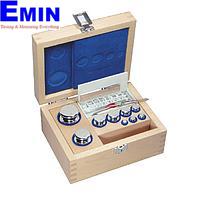
Where M2 test weights fit in everyday weighing practice
M2 class weights are commonly selected for general industrial and commercial weighing applications where dependable control of measurement accuracy is important, but where ultra-fine laboratory calibration classes may not be necessary. They are often used for routine performance checks, repeatability verification, and basic adjustment procedures on compatible weighing equipment.
In many facilities, these weights are part of a broader weighing workflow that also includes the scale itself, storage cases, and handling accessories. If you are building out a full setup, it can also be helpful to review related weighing accessories for storage, protection, and day-to-day handling support.
Available formats for different capacity ranges
This category covers several practical weight formats because different scale capacities call for different physical designs. For smaller nominal values, individual knob-style stainless steel weights and boxed sets are well suited to bench work, service use, and controlled indoor environments.
Examples include the KERN 357-01 Single Weight OIML M2 (1g, ±3mg), the KERN 357-07 Single Weight OIML M2 (100g, ±16mg), and the KERN 357-08 Standard weight with a nominal value of 200g. For users who need a compact range in one case, the KERN 354-04 Weight Set (M2, 1 g - 200 g), KERN 354-046 Weight Set (M2, 1 g - 200 g), and KERN 354-06 Weight Set (M2, 1 g - 1 kg) provide multiple values in a single kit.
For higher capacities, rectangular cast iron lacquered weights are more practical. Models such as the KERN 356-86 (5kg), KERN 356-87 (10kg), KERN 356-88 (20kg), and KERN 356-89 (50kg) are intended for larger platform scales and industrial weighing points where a heavier reference load is needed.
Materials, shape, and handling considerations
The physical design of a test weight affects how it is used and stored. Stainless steel fine-turned weights are typically chosen for smaller masses because they are convenient to handle, compact, and suitable for controlled weighing environments. Knob-shaped designs also make placement and removal easier during repeated checking routines.
Rectangular weights in cast iron are more appropriate when nominal values increase into the kilogram range. Their shape supports safer handling and more stable placement on larger weighing platforms. In practice, the choice is not only about nominal value, but also about the working environment, handling frequency, and the type of scale being verified.
How to choose the right M2 test weight
A good starting point is the capacity and readability of the scale you want to check. Small bench and portable scales often require lower-value individual weights or sets, while floor scales and higher-capacity instruments call for heavier rectangular weights. Matching the reference mass to the realistic operating range of the scale usually leads to a more useful verification routine.
You should also consider whether an individual weight or a complete set makes more sense. A single weight such as the KERN 357-06 Individual Weight (M2, 50 g) or KERN 357-09 Individual Weight (M2, 500 g) can be ideal for repeat checks at one specific point. A weight set is often more flexible when you need to test several load points or perform broader inspection procedures.
For instruments used in finer measurement tasks, it may also be worth comparing the intended application with equipment in the precision scale range or the analyzer scale category, since the balance type influences the suitable checking method and reference weight selection.
KERN solutions in this category
KERN is the featured manufacturer in this selection, with M2 weights covering small gram values through larger industrial masses. The range includes individual stainless steel weights for targeted checks, boxed sets for flexible routine verification, and rectangular cast iron weights for heavier-scale applications.
This variety makes it easier to standardize weighing control procedures across different departments. A workshop may use 5 kg to 50 kg rectangular weights on platform scales, while a laboratory or inspection station may keep 1 g to 200 g or 1 g to 1 kg sets available for smaller instruments. Keeping the format aligned with the application helps simplify handling and reduce unnecessary wear.
Typical applications across industries
Routine scale verification is one of the most common uses for M2 test weights. Warehouses, packaging lines, incoming goods inspection points, and production stations often rely on scheduled checks to confirm that weighing equipment remains within expected performance. In these settings, practical handling and repeatable placement are often just as important as nominal value selection.
These weights are also relevant in maintenance and service work, where technicians need a dependable reference for quick instrument checks after relocation, cleaning, or adjustment. In facilities using weighing for inventory, batching, or counting tasks, they support a basic but essential layer of measurement control. If counting accuracy is part of your process, related equipment in the counting scale category may also be useful.
Storage and good practice for long-term reliability
Even when the nominal value and class are correct, handling practices matter. Weights should be stored carefully, kept clean, and protected from impacts, corrosion, or unnecessary contamination. Sets supplied in wooden or aluminium cases offer a practical advantage because they help keep each piece organized and reduce the risk of damage during transport or storage.
It is also good practice to use weights consistently within a documented checking routine. That means selecting the right load points, handling the weight carefully, and returning it to its case after use. Over time, a disciplined approach helps preserve the usefulness of the reference weight and supports more stable weighing results.
Choosing with confidence
This selection of M2 test weights supports a wide range of verification needs, from small stainless steel individual weights to complete sets and heavy rectangular models. By focusing on application, weighing range, handling conditions, and the type of scale in use, it becomes easier to choose a practical reference solution rather than simply selecting by nominal value alone.
If you are equipping a new weighing station or refining an existing control procedure, M2 weights provide a straightforward foundation for routine accuracy checks. A well-matched test weight helps turn everyday scale verification into a consistent and manageable part of your measurement process.
-
-
-
-
-
-
-
-
-
-
-
-
-
-
-
-
-
-
-
-
-
-
-
-