


Test weights M1
Accurate mass standards are a basic requirement whenever a weighing system needs to be checked, adjusted, or verified in day-to-day operation. In laboratories, production areas, warehouses, and quality control environments, Test weights M1 are commonly used for routine balance testing and for maintaining confidence in measurement results across a practical range of weighing applications.
This category focuses on M1-class weights and related storage accessories used in professional weighing workflows. It is especially relevant for users working with bench scales, precision balances, and general industrial weighing equipment where a reliable reference weight is needed for regular performance checks.
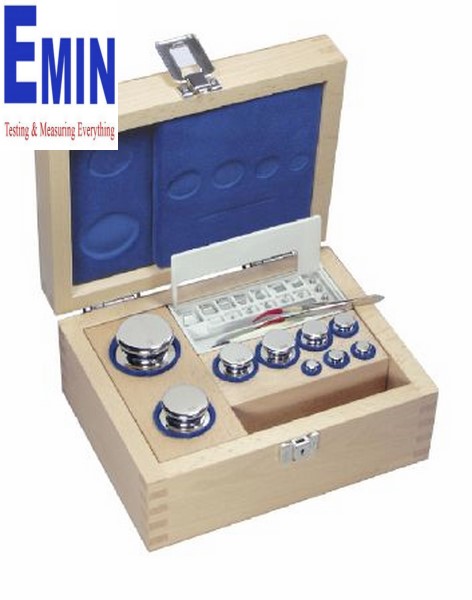
Where M1 test weights fit in practical weighing work
M1 weights are widely used as reference masses for testing and routine control of scales in industrial and laboratory settings. They help operators confirm that a weighing instrument is responding consistently and that measurement drift is detected early, before it affects process quality or stock control.
Compared with extremely fine laboratory mass standards, this class is typically chosen where the weighing task is important but still needs a practical balance between accuracy, durability, and cost. That makes the category useful for incoming inspection, workshop checks, production support, and many everyday calibration support tasks around precision scale systems.
Typical weight formats available in this category
The range shown here includes very small milligram pieces as well as heavier individual weights. For fine-value work, examples such as the KERN 348-04 10 mg, KERN 348-06 50 mg, KERN 348-07 100 mg, and KERN 348-08 200 mg illustrate the type of compact stainless steel sheet weights often used when low nominal values are required.
At the higher end, this category also includes individual M1 weights for larger nominal loads, such as the KERN 347-116 1 kg hook weight and the Cân Đông Đô M1-20kg test weight. This spread is useful because weighing systems in B2B environments do not all operate in the same range: a balance used for formulation work has very different checking needs from a scale used for goods handling or packaging control.
Materials, handling, and why storage matters
Many of the listed weights use stainless steel construction, which is a practical choice for resistance to wear, corrosion, and routine handling. In real operating environments, the long-term stability of a test weight depends not only on its class, but also on how it is stored, transported, and protected from contamination.
That is why this category also includes related containers and cases. Items such as the KERN 347-009-400 container, KERN 347-090-400 container, KERN 317-070-600 plastic box, KERN 317-080-600 plastic box, and wooden boxes like KERN 337-140-200 or KERN 337-150-200 are not just accessories; they support the full weight management workflow. Proper storage helps reduce surface damage, handling errors, and environmental contamination that could compromise repeatability over time.
For buyers building a complete setup, it can also be useful to review related weighing accessories that support routine scale operation, maintenance, and handling.
How to choose the right M1 weight for your application
The first selection factor is the weighing instrument you need to test. The nominal value of the weight should match the load range and verification routine of the scale or balance in use. Smaller nominal values are more relevant to fine-capacity instruments, while kilogram-level weights are generally chosen for larger-capacity devices or for specific test points in industrial use.
The second factor is the physical form of the weight. Flat polygonal sheet weights are convenient for very small milligram values, while larger single-piece weights may use different geometries depending on handling needs. In some situations, a hook-style format such as the KERN 347-116 is useful where the application or equipment requires that shape rather than a standard cylindrical or sheet style.
Finally, consider the operating environment. If the weight will be handled frequently, moved between departments, or stored near production areas, the right case or container is part of the purchasing decision, not an afterthought. Users who work with highly sensitive instruments may also want to compare weighing requirements with related equipment such as an Analyzer Scale when defining suitable testing routines.
Featured manufacturers in this category
KERN is one of the most visible names in this category, with examples covering milligram weights, individual heavier weights, and dedicated storage options. This makes it easier for buyers to source both the mass standard and the matching protective box within a consistent product ecosystem.
The category also includes M1 solutions from Cân Đông Đô, which is relevant for customers looking for practical industrial test weights in larger nominal values. Other manufacturers listed for the broader weighing portfolio may be relevant depending on the surrounding instrument setup, but product selection should always be based on the actual test range, handling condition, and scale class involved.
Common applications across labs and industry
In laboratory support work, M1-class weights can be used for routine performance checks on balances that do not require a higher class reference for daily control. In production and logistics, they help verify whether a scale still tracks expected values after cleaning, relocation, or continuous operation.
They are also useful in maintenance schedules where an operator needs a quick, repeatable check before starting a batch or shift. For businesses dealing with sample preparation, material issue, packaging, or inventory counting, test weights support a more controlled weighing process and help identify problems before they become quality deviations.
Where weighing is tied to material counting or process batching, adjacent categories such as Counting Scale equipment may also be relevant to the broader workflow.
What to review before ordering
Before placing an order, it is worth checking four practical points: the nominal value needed, the required OIML class, the preferred weight shape, and whether a protective container is needed. Buyers often focus on the mass value first, but transport and storage conditions can be just as important for preserving usability in the field.
If your team uses several scales with different capacities, it may be more efficient to build a small structured set rather than purchase a single weight. Likewise, if weights are shared between technicians or departments, protective packaging can improve traceability and reduce avoidable damage during routine handling.
Supporting consistent scale performance
A well-chosen M1 test weight is not just a compliance item; it is a practical tool for improving confidence in weighing results. Whether the requirement is a small stainless steel milligram piece, a heavier individual weight, or a matching storage box, the right selection depends on how the weight will actually be used in your operation.
This category is designed to help buyers source suitable M1-class weights and related accessories for routine testing, handling, and storage. By matching the weight value, format, and storage method to the instrument and working environment, it becomes much easier to maintain stable and dependable weighing performance over time.
-
-
-
-
-
-
-
-
-
-
-
-
-
-
-
-
-
-
-
-
-
-
-
-