


Test weights F2
Reliable mass verification starts with the right reference standards. In laboratories, quality control rooms, calibration workflows, and industrial weighing environments, Test weights F2 play an important role in checking whether a balance or scale is performing within the required tolerance for the task at hand.
This category focuses on OIML F2 class weights used for routine testing, adjustment support, and controlled verification across a wide range of weighing capacities. From tiny milligram values to larger stainless steel weights for heavier platforms, these reference masses help maintain confidence in measurement results and support repeatable weighing procedures.
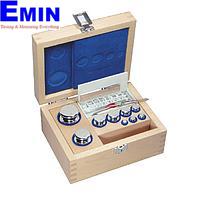
Where F2 test weights are typically used
F2 weights are commonly selected when users need a practical balance between precision and day-to-day usability. They are often used in inspection routines for laboratory balances, precision scales, and other weighing systems where controlled accuracy matters but where a higher metrology class may not be necessary for every application.
Typical use cases include routine balance checks in production, incoming quality inspection, educational and research environments, and scheduled verification in service workflows. They are also relevant when supporting instruments such as an analyzer scale or a precision scale, where stable measurement performance must be confirmed on a regular basis.
What defines the F2 class
The F2 classification refers to an OIML accuracy class for weights designed for controlled weighing and testing applications. In practice, this means each nominal value is manufactured with a defined tolerance, allowing the weight to serve as a dependable reference for checking instrument response and repeatability.
Choosing the correct class is important because the test weight should fit the accuracy level of the instrument and the process being verified. An F2 weight is not simply “a piece of metal with a mass value”; it is a reference weight intended to support traceable and consistent weighing practice when handled, stored, and used correctly.
Range of nominal values in this category
This selection covers both very small and much larger nominal values, which is useful for organizations working with different balance capacities. At the low end, milligram weights such as the KERN 338-01 1 mg, KERN 338-02 2 mg, and KERN 338-08 200 mg models are suited to fine testing tasks on sensitive instruments.
For higher-capacity weighing systems, larger single weights are available as well. Examples include the KERN 337-01 1 g test weight, the KERN 337-15 20 kg single weight, the KERN 337-141 10 kg model, and the KERN 337-161 50 kg version. This broad spread of values helps users build a testing setup that matches both small laboratory balances and heavier industrial scales.
Material, shape, and handling considerations
Many of the listed F2 weights are made from stainless steel, which is widely used because it supports dimensional stability, durability, and cleaner handling in controlled environments. Smaller milligram weights in this category are presented as flat polygonal sheet designs, while higher nominal values use more conventional turned weight formats for practical handling.
Handling method matters as much as the nominal value itself. To preserve accuracy over time, test weights should be protected from contamination, fingerprints, abrasion, and unnecessary impact. Storage boxes and accessories are therefore not just optional extras; they are part of maintaining the long-term condition of the reference mass. If you are building a complete setup, it can be useful to review related weighing accessories that support transport, storage, and routine use.
How to choose the right F2 test weight
The most practical starting point is the capacity and readability of the weighing instrument you want to check. A laboratory balance used for small samples will need very different nominal values from a floor or bench scale used for production materials. It is often better to choose weights that reflect the real operating range of the instrument instead of selecting only the maximum capacity value.
You should also consider how the weight will be used: quick daily verification, scheduled internal checks, or more formal calibration support. In some workflows, a combination of small-value and mid-range weights gives better coverage than one large weight alone. For applications tied to material loss or drying analysis, users may also compare requirements with instruments such as a moisture analyzer, where reliable weighing performance is equally important.
Representative products from KERN
This category prominently features solutions from KERN, including both compact milligram weights and heavier F2 test weights for industrial verification tasks. The KERN 338 series covers low nominal values such as 1 mg, 2 mg, 5 mg, 10 mg, 20 mg, 50 mg, and 200 mg, making it suitable for sensitive instruments and fine measurement routines.
For larger capacities, the KERN 337 series extends into gram and kilogram ranges. Products such as the 1 g KERN 337-01, the 10 kg KERN 337-141, and the 50 kg KERN 337-161 illustrate how the category supports broader weighing environments beyond the laboratory bench. This mix is helpful for users who need consistency across multiple instruments within one facility.
Why proper test weights matter in daily operations
Even a high-quality balance can drift over time due to environmental change, mechanical stress, relocation, or routine use. Using the appropriate OIML F2 weight helps operators detect deviations earlier, reduce uncertainty in production and inspection, and maintain better confidence in recorded measurement data.
In B2B settings, this has practical consequences: fewer disputes around measured quantities, more reliable internal quality checks, and better alignment between equipment performance and documented procedures. Whether the application involves analytical work, production control, or stock-based counting, verified reference masses contribute to a more disciplined weighing process. In broader workflows, this can also complement equipment such as a counting scale where dependable mass input affects counting accuracy.
Final considerations before ordering
When selecting from this category, focus on the nominal value range you actually need, the required handling format, and the environment in which the weight will be used. Small sheet-style weights are practical for highly sensitive balances, while larger stainless steel single weights are better suited to higher-capacity instruments and industrial verification routines.
A well-matched F2 weight set or single weight can make routine testing more efficient and more meaningful. If your goal is to support stable, repeatable weighing performance across laboratory or industrial equipment, this category provides a solid starting point for choosing reference masses that fit the job.
-
-
-
-
-
-
-
-
-
-
-
-
-
-
-
-
-
-
-
-
-
-
-
-