


Test weights F1
Reliable mass verification starts with stable reference standards. In laboratories, calibration rooms, and quality control environments, Test weights F1 are commonly selected when users need a high level of accuracy for checking balances, performing routine verification, or supporting calibration workflows without moving into the most demanding special classes.
This category focuses on OIML F1 weights and related accessories used in controlled weighing applications. It includes both individual weights and weight sets in different nominal values, helping users build a practical solution for analytical, precision, and small-mass measurement tasks.
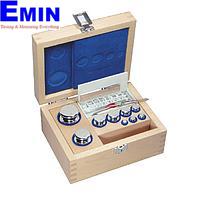
Where F1 test weights fit in weighing practice
F1 class weights are widely used for the verification and routine testing of high-resolution weighing instruments. They are relevant in environments where measurement confidence matters, such as research labs, metrology support, production inspection, and incoming quality control. The exact suitability depends on the balance readability, required uncertainty, and the procedures followed by the user.
In many setups, these weights are used together with analytical balances or precision scales to confirm that the instrument is performing consistently across the required range. This makes the category relevant not only for calibration work, but also for routine checks before critical weighing operations.
Available formats in this category
The range includes single weights, compact milligram weights, and complete weight sets for different workflows. For larger nominal values, products such as KERN 326-11 OIML F1 Single weight (1kg), KERN 326-12 OIML F1 Single weight (2kg, ±10 mg), and KERN 326-13 OIML F1 Single weight (5kg, 25mg) are suitable when a specific reference point is needed for a balance capacity or test routine.
For finer work, smaller denominations are available in both individual and set formats. Examples include the KERN 324-034 F1 Set of weights (1g - 100g), the KERN 328-226 Set of weights OIML F1 (1mg~500mg), and individual milligram weights such as KERN 328-09 500mg, KERN 328-08 200mg, KERN 328-06 50mg, KERN 328-05 20mg, and KERN 328-03 5mg. This mix helps users choose between a full weighing kit and a targeted replacement or expansion item.
Material, handling, and storage considerations
Many of the listed F1 weights are made from polished stainless steel, a practical material for stable handling and resistance to contamination in normal laboratory use. Surface condition matters because dust, fingerprints, and residue can influence the effective mass, especially in low-value and milligram ranges.
Proper handling accessories are therefore part of the overall solution, not an afterthought. The KERN 315-243 tweezer for E1 - F1 classes is intended to reduce direct contact during handling of small weights, while storage items such as the KERN 317-030-100 Wooden Box for Single Weights (E1 - F1) help protect weights between uses. Users looking for supporting tools can also explore weighing accessories for a more complete setup.
How to choose the right F1 weight or set
The first selection point is the nominal value range you need to test. If the goal is a quick repeatability or corner check at one operating point, a single weight may be enough. If the application requires multi-point verification, substitution checks, or work across a wide weighing range, a structured set is usually more practical.
The second factor is the physical form of the weight. Larger kilogram weights are appropriate for instrument checks at higher capacities, while flat polygonal sheet weights in the milligram range are better suited to fine mass work. It is also worth considering storage and handling from the beginning, especially if weights will be used frequently or shared between operators.
Finally, make sure the selected class aligns with the instrument and procedure in use. For highly sensitive weighing tasks, users often compare the intended workflow with the specifications of the balance, environmental controls, and the expected test uncertainty before choosing the weight class and denomination mix.
KERN products highlighted in this range
KERN is the most prominent manufacturer represented in this category, with a selection that covers kilogram weights, gram-to-milligram sets, and handling accessories. This makes it easier for buyers to source matching items within one product family, especially when consistency of storage format and accessory compatibility is important.
Representative options include the KERN 326 series for individual kilogram-class weights, the KERN 324-034 set for general small-mass applications, and the KERN 328 series for fine milligram denominations. Instead of treating all products as interchangeable, it is better to choose based on the real testing routine: larger weights for capacity-related checks, sets for flexible verification, and small sheet weights for fine adjustment or low-mass testing tasks.
Typical application scenarios
In a laboratory, F1 weights may be used as part of scheduled balance verification before sample preparation or formulation work. In production or QA areas, they can support routine instrument checks at defined intervals to reduce the risk of unnoticed weighing drift. They are also relevant in educational and technical environments where controlled weighing procedures need traceable, repeatable reference masses.
These weights can support applications beyond standard bench balances as well. For example, users working with sample moisture determination may review related equipment such as a moisture analyzer when building a broader weighing and testing workflow, although the exact weight requirements still depend on the instrument and method used.
Good practice for long-term accuracy
Even a well-made test weight should be handled carefully to preserve its usefulness over time. Keep weights clean, avoid unnecessary touching, return them to their box after use, and use suitable tools for smaller denominations. Environmental control is also important, since drafts, vibration, and contamination can affect the weighing result as much as the weight itself.
For teams managing multiple balances, it is often helpful to assign dedicated test weights to specific instruments or work areas. This supports better traceability in internal procedures and reduces the chance of damage or mixing. When users choose the right denomination range, handling tools, and storage method together, F1 weights become a reliable part of day-to-day measurement control.
Conclusion
This category is designed for users who need dependable OIML F1 reference weights for balance verification, routine testing, and precision weighing support. Whether the requirement is a single 1 kg, 2 kg, or 5 kg weight, a gram-range set, or fine milligram pieces, the selection helps cover both general and detailed weighing tasks.
If you are comparing options, focus on the weighing range you need to test, the instrument type, and the handling conditions in your environment. A well-matched F1 weight solution can improve consistency in daily checks and make calibration-related workflows more controlled and repeatable.
-
-
-
-
-
-
-
-
-
-
-
-
-
-
-
-
-
-
-
-
-
-
-
-