


Test weights E2
Accurate mass reference is essential when calibrating high-resolution balances, verifying repeatability, or maintaining traceable weighing processes in laboratories and quality control environments. Test weights E2 are commonly selected for demanding applications where very tight tolerances matter and where the performance of the weighing instrument must be checked with confidence.
Within this category, users can find E2-class single weights, milligram weights, and weight sets suited to different calibration routines. The range is especially relevant for organizations working with analytical and high-precision weighing systems, where even small deviations can affect test results, formulation accuracy, or process validation.
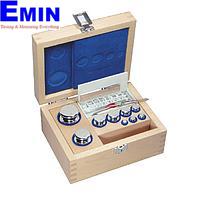
Where E2 test weights are typically used
E2 weights are generally chosen for calibration, routine verification, and reference checks on balances that operate at a very fine readability. They are often used in laboratories, pharmaceutical workflows, research settings, metrology routines, and controlled production environments where measurement consistency is critical.
They are also a practical fit for users working with analytical balances and other high-resolution instruments that need a reference standard aligned with the level of accuracy expected from the device. In many cases, the correct weight class helps reduce uncertainty during routine checks and supports better long-term control of weighing performance.
What defines the E2 class in practical terms
The key reason engineers and lab users choose this category is the combination of tight tolerance, stable construction, and suitability for precise balance verification. In practical use, E2 weights are intended for applications above general industrial weighing, especially where calibration quality has a direct effect on data reliability.
Most products shown in this category use polished stainless steel and are designed in forms appropriate to their nominal values, such as cylindrical bodies for larger weights and flat or platelet-style formats for very small masses. This matters because the physical form influences handling, storage, and the ability to use tweezers or protective cases during fine calibration work.
Available formats across the category
This category includes both single weights and weight sets, making it suitable for users who either need one defined reference point or a broader calibration kit. For example, larger reference points are represented by products such as the KERN 317-15 E2 Single Weight (20 kg, ±30 mg) and the KERN 317-14 E2 Single Weight (10 kg, ±16 mg), while mid-range verification can be supported by models such as the KERN 317-08 E2 Single Weight (200 g, ±0.3 mg).
For finer work, smaller nominal values are also available, including the KERN 317-03 Single weights OIML E2 (5 g), the KERN 318-09 E2 Milligram Weight (500 mg, ±0.025 mg), the KERN 318-08 E2 Milligram Weight (200 mg, ±0.02 mg), and the KERN 318-07 E2 Milligram Weight (100 mg, ±0.016 mg). Users needing a wider working range may prefer sets such as the KERN 314-02 E2 Set of weights (1 g - 50 g) or the KERN 318-22-2024a Weight set (1 mg - 500 mg).
How to choose the right E2 test weight
A good starting point is the balance or weighing system you need to verify. The selected nominal value should match the intended test point, while the weight class should be appropriate for the instrument’s readability and the required calibration method. If you are checking small-capacity laboratory instruments, low-mass single weights or milligram sets are often more relevant than large cylindrical weights.
It is also important to think about the operating routine. A single weight may be enough for repeated verification at one control point, but a set is often more efficient when multiple values are needed for adjustment, linearity checks, or broader calibration procedures. If your weighing workflow includes regular transport or storage between controlled locations, protective storage solutions from the wider weighing accessories range can also be useful.
Examples from KERN and the wider precision weighing ecosystem
KERN is strongly represented in this category with E2-class weights covering a broad nominal range, from milligram formats up to kilogram-class single weights. This makes the range relevant for both micro-level verification tasks and heavier calibration points in advanced weighing environments. The category also includes supporting items such as the KERN 317-060-600 Aluminium protective box, which highlights the importance of storage and handling in preserving weight condition.
In the broader weighing ecosystem, users may also compare requirements across brands such as Mettler Toledo when standardizing calibration workflows or aligning equipment choices across a lab or production site. Even when the weight itself is the focus, the surrounding process, instrument quality, and handling discipline all influence final measurement reliability.
Handling and storage considerations
With E2-class weights, proper handling is not a minor detail. Surface contamination, accidental contact, or unsuitable storage can affect the usable condition of a weight over time. That is why many precision weights are supplied with, or can be paired with, dedicated cases made from materials such as aluminium, plastic, or wood depending on the model and size.
For users working at very fine mass values, careful handling becomes even more important. Milligram and sub-gram references should typically be managed in a controlled way to avoid introducing avoidable error during calibration or verification. This is one reason many laboratories pair reference weights with suitable precision scales and documented handling procedures.
When a set is better than a single weight
A single E2 weight is often the right choice when a process requires fast, repeatable checks at one nominal value. This can be useful for routine verification schedules, incoming inspection of balances, or periodic confirmation of a known measuring point. It is also a straightforward option when replacement of a specific reference weight is needed.
A set becomes more practical when the workflow calls for flexibility. Weight sets covering ranges such as 1 g to 50 g or 1 mg to 500 mg are useful for multipoint checks, lab training, and applications where several fine values are required in one compact case. This can simplify calibration preparation and reduce the need to source individual pieces separately.
Choosing with confidence for precision calibration work
The right E2 reference weight depends on more than nominal value alone. Users should consider the target instrument, required tolerance level, handling conditions, and whether a single weight or full set better matches the calibration routine. Looking at material, form factor, and storage options can also help ensure the weight remains suitable for long-term use.
This category is designed for buyers who need dependable options for fine weighing control, from compact milligram references to larger stainless steel calibration weights. Whether the goal is routine balance verification, structured calibration work, or building a more complete weighing setup, selecting the appropriate E2-class product can support more stable and trustworthy measurement results.
-
-
-
-
-
-
-
-
-
-
-
-
-
-
-
-
-
-
-
-
-
-
-
-