


Blackbody Calibrators
Accurate non-contact temperature measurement depends on more than the infrared instrument itself. When an IR thermometer or thermal imaging device needs to be verified, adjusted, or checked against a known reference, Blackbody Calibrators provide a stable and repeatable radiation source that supports dependable calibration workflows in laboratories, maintenance teams, and industrial quality environments.
On this page, you can explore blackbody calibration equipment designed for different temperature ranges, portability requirements, and reference needs. The category is especially relevant for users working with infrared thermometers, thermal sensors, and inspection systems that rely on emissivity-controlled targets and consistent temperature stability.
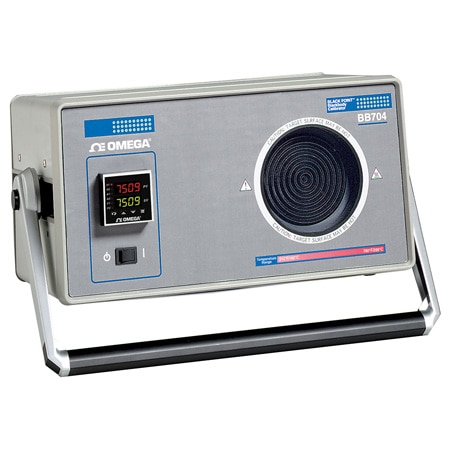
Why blackbody calibration matters
A blackbody calibrator generates a controlled target surface or cavity with known emissivity, allowing non-contact temperature devices to compare their readings against a reference source. This is important because infrared measurement accuracy can be influenced by distance, target size, ambient conditions, and the characteristics of the measured surface.
In practical terms, these instruments help users confirm whether an IR device is reading within acceptable tolerance before it is used in production, maintenance, inspection, or testing. For broader comparison across temperature calibration methods, it can also be useful to review other dry block calibrator options when contact probes and sensors are part of the same workflow.
Typical applications for Blackbody Calibrators
This category is commonly used wherever non-contact temperature instruments must be checked in a controlled way. Typical use cases include calibration of handheld infrared thermometers, verification of thermal imagers, support for preventive maintenance programs, and quality control tasks where temperature indication has to remain consistent over time.
Blackbody sources are also helpful in service and field environments because many models are designed to be portable while still offering stable control. Compared with contact-based methods, they are particularly relevant when the instrument under test reads radiant energy rather than direct sensor contact.
Temperature range and performance considerations
Selection usually starts with the required operating range. Some models in this category are intended for lower-temperature work, such as the OMEGA BB701 series, which covers sub-ambient to moderate temperatures, making it suitable for applications where infrared devices are used near cold storage or low-temperature process conditions.
For ambient to mid-range verification, examples such as the OMEGA BB702 and BB703 families cover ranges from around 10 °C up to 215 °C or 400 °C, depending on model. Where higher-temperature infrared calibration is required, the OMEGA BB704 extends toward 398 °C, while the OMEGA BB-4A reaches up to 982 °C, which is more appropriate for demanding thermal process environments.
Beyond temperature span, buyers typically compare accuracy, stability, warm-up time, target size, and available interfaces. A stable source with suitable emissivity and enough target area helps improve confidence when aligning the instrument optics and validating readings.
How to choose the right unit for your setup
The best fit depends on the instrument being calibrated and the way it is used. A compact portable unit may be more practical for field verification, while a wider-range model may be better suited to maintenance labs or central calibration benches. If the infrared device has a larger spot size at the intended working distance, target area becomes an important consideration to avoid measuring outside the reference surface.
Power supply is another simple but important detail, since several models are available in 115 Vac and 230 Vac versions. Communication features such as RS232 may also matter if the calibration process needs to be documented or integrated into a broader quality system. For users comparing non-contact and contact calibration approaches, the wider blackbody calibrator range can be reviewed alongside alternatives for probe-based testing.
Featured OMEGA models in this category
OMEGA is the main manufacturer represented here, with several portable blackbody calibrators covering different application windows. The BB701 models support lower-temperature calibration, the BB702 series addresses ambient to 215 °C applications, and the BB703 series extends to 400 °C with compact form factors suitable for flexible use.
For higher-temperature needs, the BB704 models provide a portable blackbody source up to 398 °C with PID control and RS232 communication, while the BB-4A is intended for substantially hotter operating ranges up to 982 °C. These examples illustrate how the category supports both routine infrared instrument checks and more demanding thermal calibration tasks.
Where blackbody calibrators fit in a calibration ecosystem
Blackbody devices are not a replacement for every temperature calibration method. They are most appropriate when the instrument under test measures emitted radiation rather than direct contact temperature. In many facilities, they are used alongside contact calibration tools to support different sensor types, maintenance procedures, and validation requirements.
For example, teams working with RTDs, thermocouples, and process probes may also use dry block and bath calibrator solutions for contact sensors, while infrared instruments are checked with a blackbody source. If a reference near 0 °C is needed for specific sensor validation tasks, ice point calibrators may also be relevant in the same calibration program.
What to review before ordering
Before selecting a model, confirm the required calibration temperature range, the expected accuracy of the instrument under test, and the target size needed for proper optical alignment. It is also worth checking warm-up behavior, site power availability, and whether digital communication is necessary for records or reporting.
In addition, think about where the unit will be used. Portable systems can be advantageous for plant-wide verification, while bench-oriented workflows may prioritize repeatability and a wider temperature span. A good selection process focuses on application fit rather than simply choosing the highest range available.
Final thoughts
Blackbody Calibrators are a practical solution for verifying and supporting the accuracy of infrared temperature instruments across low, mid, and high temperature applications. By comparing range, stability, accuracy, target size, and portability, buyers can narrow down the most suitable option for their testing environment.
If your calibration work includes both non-contact devices and contact probes, it often makes sense to evaluate blackbody equipment as part of a broader temperature calibration strategy. The products in this category provide a useful starting point for building a more consistent and traceable IR measurement process.
-
-
-
-
-
-
-
-
-
-
-
-
-
-
-
-
-
-
-
-
-
-
-
-