


Clean Booth
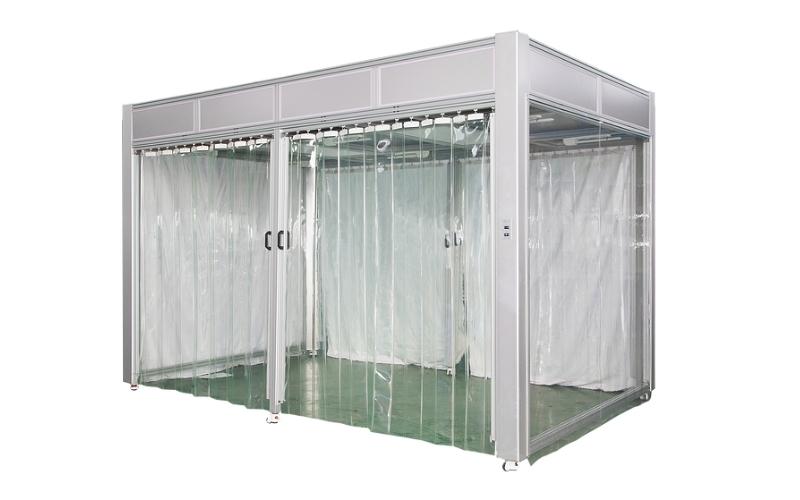
Creating a controlled workspace is often more practical than building a full clean room, especially when only a specific production, inspection, or packing area needs cleaner air. In those cases, a Clean Booth provides a focused solution that helps reduce airborne particles around sensitive processes while keeping installation scope and operating requirements more manageable.
Clean booths are commonly used in electronics assembly, laboratory support areas, precision component handling, and other environments where localized cleanliness matters. This category brings together booth configurations designed around laminar airflow and FFU-based air delivery, making it easier to compare size, layout, and suitability for the intended work zone.
Why clean booths are used in controlled environments
A clean booth helps isolate a work area from the surrounding environment by supplying filtered air in a stable, directional pattern. This approach is especially useful when a production line, inspection station, or material preparation area requires cleaner conditions, but a full-room upgrade would be unnecessary or inefficient.
In practical terms, a booth supports localized contamination control. It can reduce the exposure of products, components, or samples to dust and other airborne particles, while also giving users flexibility in where the protected workspace is installed within a larger facility.
How laminar airflow supports cleaner processing zones
Many clean booth systems rely on laminar airflow, where filtered air moves in a consistent direction across the protected area. This airflow pattern helps carry particles away from the work zone instead of allowing them to circulate unpredictably. In clean processing, assembly, and inspection tasks, that airflow behavior is a key factor in maintaining a stable environment.
The products listed in this category include VAF booth configurations designed with different numbers of FFUs and installation footprints. That makes it possible to align the booth size with the actual workspace requirement, whether the need is for a compact operation cell or a larger enclosed process area.
Typical clean booth configurations in this category
Available examples in this range include compact and larger-format VAF solutions such as the VAF V-LAF-01C, VAF V-LAF-02C, and VAF V-LAF-03C series. These models are presented in multiple dimensions and FFU counts, from a smaller 1-FFU configuration up to larger systems with 12 FFUs for broader working zones.
Rather than treating every booth as interchangeable, it is important to match the enclosure dimensions, airflow coverage, and power requirements to the real process. For example, a smaller booth may be suitable for a single workstation or handling point, while larger configurations are better aligned with multi-operator work areas, transfer zones, or grouped equipment stations.
How to choose the right clean booth
The first selection point is the size of the protected area. Booth dimensions should reflect not only the equipment footprint, but also operator movement, material transfer, and clearance around the process. Choosing too small a unit can create workflow limitations, while an oversized booth may increase energy use and take up unnecessary floor space.
The second factor is FFU quantity and airflow coverage. More FFUs generally support wider or longer booth structures, helping maintain more consistent air delivery across the working zone. In this category, the available VAF models range from single-FFU designs to larger multi-FFU layouts, which gives buyers a clearer path when scaling from a bench-level application to a room-within-a-room concept.
Power supply is also an important planning detail. The featured models in this category use 220VAC, 50Hz, 1-phase power, so site compatibility should be confirmed early in the project. For many facilities, this makes installation planning more straightforward, but final suitability still depends on the local electrical setup and the total equipment load around the booth.
Where clean booths fit within a wider cleanroom workflow
A clean booth is often only one part of a broader contamination-control process. Before materials or operators enter the protected workspace, facilities may also use an air shower to reduce particles carried in from adjacent areas. This helps improve the overall effectiveness of the localized clean zone.
For smaller open-front operations, some users may also compare a booth with a clean bench. While both support cleaner working conditions, the choice depends on whether the application requires a more enclosed workspace, larger operator area, or broader airflow coverage. In cleaning and maintenance routines around controlled environments, support items such as dustcloth and mop products may also play a practical role in maintaining surrounding areas.
Featured manufacturer and product context
This category highlights solutions from VAF, with multiple clean booth sizes built around the same general airflow concept. The available range helps buyers compare compact and large-format structures without jumping between unrelated product families. That is useful when standardization, installation planning, and maintenance consistency are part of the purchasing criteria.
Representative products include VAF V-LAF-01C for smaller booths, VAF V-LAF-02C for intermediate setups, and VAF V-LAF-03C variants for larger controlled spaces. The differences in physical dimensions and FFU count are especially relevant for engineering teams trying to balance cleanliness targets, floor layout, and operational access.
Applications commonly supported by clean booths
Clean booths are well suited to tasks where product exposure needs to be controlled within a defined area rather than across an entire room. Common use cases include electronics handling, precision assembly, visual inspection, sample preparation, light packaging, and pre-clean processing steps where airborne contamination can affect quality or repeatability.
They are also valuable when a facility needs a modular or scalable approach. Instead of redesigning the whole workspace, teams can establish a cleaner micro-environment around the process that matters most. This makes clean booths a practical option for pilot lines, expanding production cells, and facilities that need more flexibility in layout and future changes.
Planning for installation and long-term use
Beyond booth size and airflow, buyers should consider installation height, operator access, maintenance access to FFUs, and how materials move in and out of the enclosure. A well-chosen booth should support the process without creating bottlenecks in routine work. Thinking through workflow at the start usually leads to better long-term performance than selecting only by footprint.
When comparing products in this category, it helps to review dimensions, FFU count, and electrical requirements together rather than in isolation. That gives a more realistic picture of how each booth will function in the intended application and how easily it can be integrated into the site’s existing cleanroom or controlled-environment practices.
For organizations that need targeted air cleanliness around a specific workstation or production zone, this clean booth range offers a practical starting point. By matching booth size, airflow coverage, and workspace needs carefully, buyers can build a controlled area that supports process quality without overcomplicating the wider facility environment.
-
-
-
-
-
-
-
-
-
-
-
-
-
-
-
-
-
-
-
-
-
-
-
-